Notícia
22 de Setembro de 2026Workshop ''Platforms as Epistemic Infrastructures: Producing, Organizing and Contesting Knowledge''
(See below full information in English)
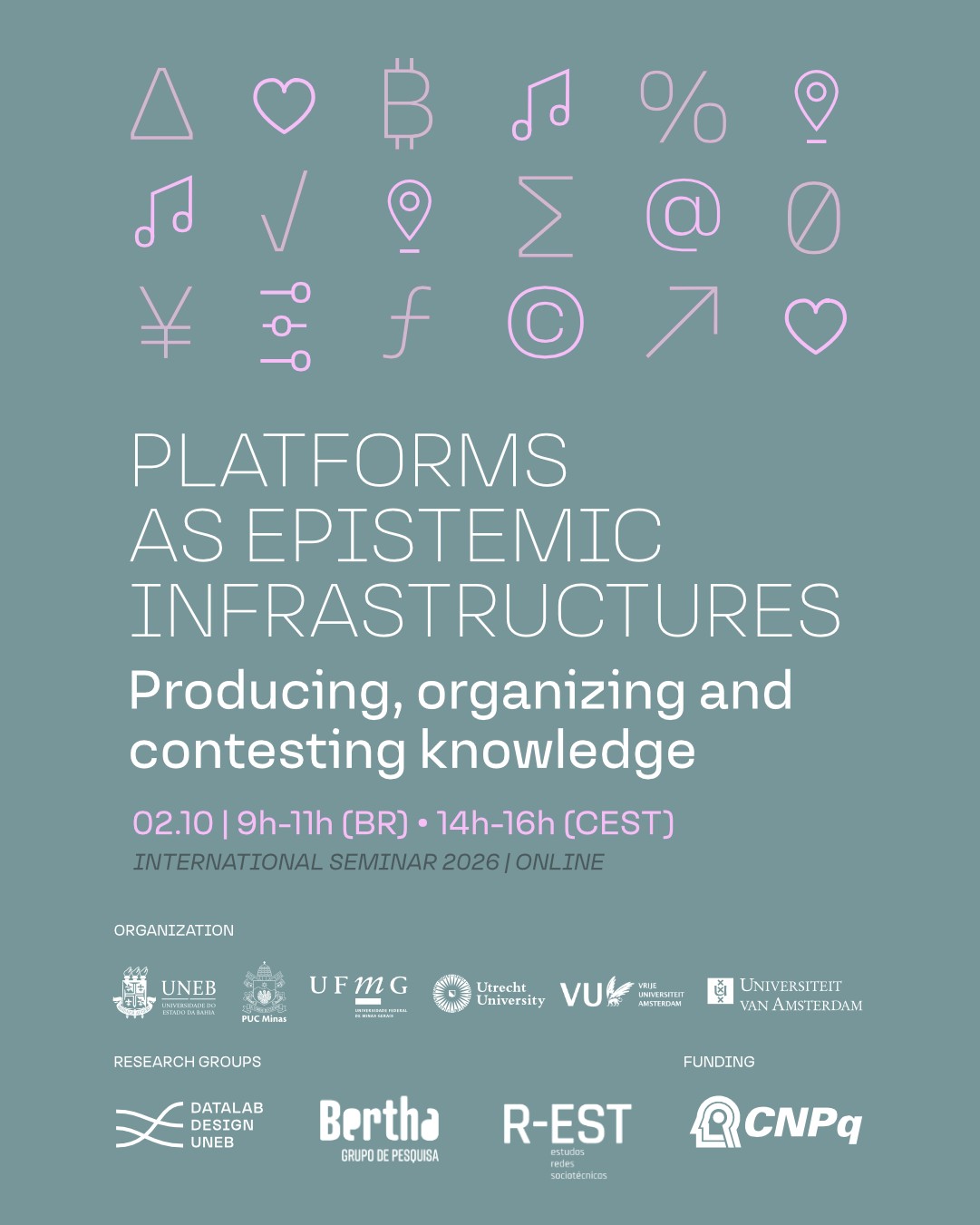
Como parte das atividades de projeto financiado pelo CNPq através da Chamada Pública MCTI/CNPq nº16/2024 - Apoio a Projetos Internacionais de Pesquisa Científica, Tecnológica e de Inovação, acontece na sexta, dia 02 de outubro de 2026, o workshop online “Platforms as Epistemic Infrastructures: Producing, Organizing and Contesting Knowledge”.
O evento será em inglês, conforme informações abaixo.
Platforms as Epistemic Infrastructures: Producing, Organizing and Contesting Knowledge
Friday, October 2nd, 2026
9 to 11 a.m. (Brasília) / 2 to 4 p.m. (CEST)
Registration: https://docs.google.com/forms/d/e/1FAIpQLSfcBu1BDiRWvGTjPuUihmsS4U2d1gdJtq0a1sJRpwBt4dhH8g/viewform
Digital platforms have become increasingly entangled with the ways in which knowledge is produced, organized, circulated, and contested. Rather than simply providing channels for the dissemination of knowledge, platforms can be understood as epistemic infrastructures: sociotechnical arrangements that shape what becomes visible, measurable, knowable, and actionable. Building on the discussions developed in the first editions of the event, this third meeting brings together contributions that examine different configurations of epistemic infrastructures across science, sustainability, climate knowledge, sports, and popular culture. The presentations explore how data, technologies, metrics, and material arrangements participate in the production and organization of knowledge, while also drawing attention to the tensions, disruptions, and forms of appropriation that emerge around these infrastructures.
The event seeks to explore how epistemic infrastructures are continuously produced and maintained through situated practices. It also asks how these infrastructures can be destabilized, contested, or reconfigured, and how different actors develop their own ways of knowing and acting within them. Funded by the Brazilian research fund MCTI/CNPq, the workshop results from a cooperation between three Brazilian universities – Federal University of Minas Gerais/UFMG (Carlos d’Andréa and Natália Dias), Universidade do Estado da Bahia/UNEB (Elias Bitencourt), Pontifícia Universidade Católica de Minas Gerais/Puc Minas (Verônica Soares da Costa) –and three Dutch universities - University of Amsterdam (Markus Stauff), Utrecht University (Donya Alinejad) and Vrije Universiteit Amsterdam (Judith Keilbach).
PROGRAMME
Opening - 9 a.m. (Brasília) / 2 p.m (CEST)
Session 1 - Climate, Sustainability and Knowledge Infrastructures - 9:10 a.m. / 2:10 p.m
Donya Alinejad (UU, NL) and coauthors
Judith Keilbach (VU, NL)
Chair: Carlos d’Andréa (UFMG, BRA)
Session 2 - Sports, Fandoms and Knowledge Practices - 9:55 a.m / 2:55 p.m.
Markus Stauff (UvA, NL)
Natália Santos Dias (UFMG, BRA)
Chair: Elias Bitencourt (UNEB, BRA)
Closing remarks - 10:45 a.m / 3:45 p.m.
ABSTRACTS
Understanding Sustainability Science’s Digital Solutionism
Donya Alinejad / Co-authors: Chiara de Groot, Roos Korderijnk, and Alya Khairunnisa.
While tech-solutionist narratives about sustainable transitions have been researched in policy and marketing, far less is known about how such narratives pervade scientific knowledge about sustainability. This paper’s object of study is academic output (88 peer-reviewed articles) from sustainability studies’ most impactful journals, with an analytical focus on the theme of digital communication technologies' environmental sustainability impacts. Besides revealing an overwhelming share of optimistic accounts about digital technologies, our combined qualitative and quantitative analysis traces the threads of these narratives to eco-modernist ideas and green growth policy frameworks. Our argument offers 1) a cautionary tale about the over-alignment of science with policy, 2) a contribution to the conceptual discussion about sustainability policy frameworks as epistemic infrastructures, and 3) a methodological plea for expanding our study of digital technologies from seeing ICTs as tools for environmental communication to understanding them as far-reaching systems with material and epistemic consequences.
Climate knowledge infrastructure’s (in)stability: an overview
Judith Keilbach
Like other epistemic infrastructures, the climate knowledge infrastructure consists of interlocking technical systems” (Edwards, 2010, xvi) that collect and interpret data, produce models, and evaluate their performance. Lately, this global infrastructure has been increasingly destabilized by, among other factors, the growing political influence of climate change skeptics in governments. Climate scientists are being laid off, servers are being shut down, and monitoring technologies are being decommissioned. This presentation provides an overview of the climate knowledge infrastructure and discusses its stability. It is particularly interested in the utilization of climate data in the production of non-knowing about climate change.
Blurred Boundaries: Logistics of Knowledge in Sports TV and Performance Analysis
Markus Stauff
This contribution takes media sports as a key case for understanding epistemic infrastructures as an assemblage of highly diverse media technologies and knowledge cultures. To safeguard its competitive character, sports have established globally standardized procedures to evaluate the performances. I will first offer an overview of how, historically, ever more media forms - from league tables via video replay to data visualizations - have been incrementally integrated into these procedures, often related to tense debates concerning the epistemic virtues of the respective media forms. Additionally, throughout this history, sports is characterized by blurred boundaries between professional expertise and popular knowledge. Using examples from different sports (e.g. mixed martial arts and football), I will analyse how such blurred boundaries are related to a complex logistics of knowledge in which the circulation of data and images are optimized for specific uses but constantly get re-appropriated by unruly knowledge practices.
Machineries of Platformatized Fandoms: 'Chartfãs' and Metric Performance in Pop Music
Natália Santos Dias
In the context of platformatized music ecosystems, fandom functions as an epistemic culture (Knorr-Cetina, 2007), playing a key role in the production of the very mechanisms through which metric performance is recognised, measured and debated. Based on our empirical research with B-ARMYs (Brazilian fans of the South Korean group BTS), we explore the emergence of the self-declared 'chartfã', a strategic actor whose identity is shaped by rituals of constant monitoring and engagement with music charts. Within this infrastructure, streaming metrics operate within a logic of information-knowledge consumption (Knorr-Cetina, 2007), in which data acts as 'news' that rapidly changes in terms of both relevance and visibility, requiring collective responses. In order to manage this volatile environment, chartfãs create specialized objects of expertise, such as spreadsheets, dashboards and tutorials, that discipline fan behaviour and convert metrics into actionable knowledge. By articulating Bandola-Gill's (2023) levels of 'materialities', 'interconnections', and 'governance' alongside the framework of knowledge machineries (Knorr-Cetina, 2007), we demonstrate the deep intertwining of micro-level fan activities and macro-level platform infrastructures, showing that metric visibility in the contemporary music industry is co-produced by the ongoing feedback loop between fan labour and algorithmic architectures.
Como parte das atividades de projeto financiado pelo CNPq através da Chamada Pública MCTI/CNPq nº16/2024 - Apoio a Projetos Internacionais de Pesquisa Científica, Tecnológica e de Inovação, acontece na sexta, dia 02 de outubro de 2026, o workshop online “Platforms as Epistemic Infrastructures: Producing, Organizing and Contesting Knowledge”.
O evento será em inglês, conforme informações abaixo.
Platforms as Epistemic Infrastructures: Producing, Organizing and Contesting Knowledge
Friday, October 2nd, 2026
9 to 11 a.m. (Brasília) / 2 to 4 p.m. (CEST)
Registration: https://docs.google.com/forms/d/e/1FAIpQLSfcBu1BDiRWvGTjPuUihmsS4U2d1gdJtq0a1sJRpwBt4dhH8g/viewform
Digital platforms have become increasingly entangled with the ways in which knowledge is produced, organized, circulated, and contested. Rather than simply providing channels for the dissemination of knowledge, platforms can be understood as epistemic infrastructures: sociotechnical arrangements that shape what becomes visible, measurable, knowable, and actionable. Building on the discussions developed in the first editions of the event, this third meeting brings together contributions that examine different configurations of epistemic infrastructures across science, sustainability, climate knowledge, sports, and popular culture. The presentations explore how data, technologies, metrics, and material arrangements participate in the production and organization of knowledge, while also drawing attention to the tensions, disruptions, and forms of appropriation that emerge around these infrastructures.
The event seeks to explore how epistemic infrastructures are continuously produced and maintained through situated practices. It also asks how these infrastructures can be destabilized, contested, or reconfigured, and how different actors develop their own ways of knowing and acting within them. Funded by the Brazilian research fund MCTI/CNPq, the workshop results from a cooperation between three Brazilian universities – Federal University of Minas Gerais/UFMG (Carlos d’Andréa and Natália Dias), Universidade do Estado da Bahia/UNEB (Elias Bitencourt), Pontifícia Universidade Católica de Minas Gerais/Puc Minas (Verônica Soares da Costa) –and three Dutch universities - University of Amsterdam (Markus Stauff), Utrecht University (Donya Alinejad) and Vrije Universiteit Amsterdam (Judith Keilbach).
PROGRAMME
Opening - 9 a.m. (Brasília) / 2 p.m (CEST)
Session 1 - Climate, Sustainability and Knowledge Infrastructures - 9:10 a.m. / 2:10 p.m
Donya Alinejad (UU, NL) and coauthors
Judith Keilbach (VU, NL)
Chair: Carlos d’Andréa (UFMG, BRA)
Session 2 - Sports, Fandoms and Knowledge Practices - 9:55 a.m / 2:55 p.m.
Markus Stauff (UvA, NL)
Natália Santos Dias (UFMG, BRA)
Chair: Elias Bitencourt (UNEB, BRA)
Closing remarks - 10:45 a.m / 3:45 p.m.
ABSTRACTS
Understanding Sustainability Science’s Digital Solutionism
Donya Alinejad / Co-authors: Chiara de Groot, Roos Korderijnk, and Alya Khairunnisa.
While tech-solutionist narratives about sustainable transitions have been researched in policy and marketing, far less is known about how such narratives pervade scientific knowledge about sustainability. This paper’s object of study is academic output (88 peer-reviewed articles) from sustainability studies’ most impactful journals, with an analytical focus on the theme of digital communication technologies' environmental sustainability impacts. Besides revealing an overwhelming share of optimistic accounts about digital technologies, our combined qualitative and quantitative analysis traces the threads of these narratives to eco-modernist ideas and green growth policy frameworks. Our argument offers 1) a cautionary tale about the over-alignment of science with policy, 2) a contribution to the conceptual discussion about sustainability policy frameworks as epistemic infrastructures, and 3) a methodological plea for expanding our study of digital technologies from seeing ICTs as tools for environmental communication to understanding them as far-reaching systems with material and epistemic consequences.
Climate knowledge infrastructure’s (in)stability: an overview
Judith Keilbach
Like other epistemic infrastructures, the climate knowledge infrastructure consists of interlocking technical systems” (Edwards, 2010, xvi) that collect and interpret data, produce models, and evaluate their performance. Lately, this global infrastructure has been increasingly destabilized by, among other factors, the growing political influence of climate change skeptics in governments. Climate scientists are being laid off, servers are being shut down, and monitoring technologies are being decommissioned. This presentation provides an overview of the climate knowledge infrastructure and discusses its stability. It is particularly interested in the utilization of climate data in the production of non-knowing about climate change.
Blurred Boundaries: Logistics of Knowledge in Sports TV and Performance Analysis
Markus Stauff
This contribution takes media sports as a key case for understanding epistemic infrastructures as an assemblage of highly diverse media technologies and knowledge cultures. To safeguard its competitive character, sports have established globally standardized procedures to evaluate the performances. I will first offer an overview of how, historically, ever more media forms - from league tables via video replay to data visualizations - have been incrementally integrated into these procedures, often related to tense debates concerning the epistemic virtues of the respective media forms. Additionally, throughout this history, sports is characterized by blurred boundaries between professional expertise and popular knowledge. Using examples from different sports (e.g. mixed martial arts and football), I will analyse how such blurred boundaries are related to a complex logistics of knowledge in which the circulation of data and images are optimized for specific uses but constantly get re-appropriated by unruly knowledge practices.
Machineries of Platformatized Fandoms: 'Chartfãs' and Metric Performance in Pop Music
Natália Santos Dias
In the context of platformatized music ecosystems, fandom functions as an epistemic culture (Knorr-Cetina, 2007), playing a key role in the production of the very mechanisms through which metric performance is recognised, measured and debated. Based on our empirical research with B-ARMYs (Brazilian fans of the South Korean group BTS), we explore the emergence of the self-declared 'chartfã', a strategic actor whose identity is shaped by rituals of constant monitoring and engagement with music charts. Within this infrastructure, streaming metrics operate within a logic of information-knowledge consumption (Knorr-Cetina, 2007), in which data acts as 'news' that rapidly changes in terms of both relevance and visibility, requiring collective responses. In order to manage this volatile environment, chartfãs create specialized objects of expertise, such as spreadsheets, dashboards and tutorials, that discipline fan behaviour and convert metrics into actionable knowledge. By articulating Bandola-Gill's (2023) levels of 'materialities', 'interconnections', and 'governance' alongside the framework of knowledge machineries (Knorr-Cetina, 2007), we demonstrate the deep intertwining of micro-level fan activities and macro-level platform infrastructures, showing that metric visibility in the contemporary music industry is co-produced by the ongoing feedback loop between fan labour and algorithmic architectures.